The confusion starts with the language
Most teams talk about Agile like it is a process you install.
"We are doing Agile now."
Usually that means the team has daily standups, two-week sprints, a backlog, planning, reviews, retrospectives, and maybe a velocity chart somewhere in the project management tool. In other words, they are probably doing Scrum.
That is not the same thing.
Scrum is a framework. Agile is a set of values and principles. Scrum can help a team work in an agile way, but it can also become a ritual machine that produces meetings without producing better software.
The difference matters because when teams confuse Scrum with Agile, they often optimize the wrong thing.
Scrum is a framework
Scrum gives a team structure.
It defines roles, events, artifacts, and a rhythm for delivery. A product owner manages the product direction. A scrum master protects the process. Developers turn backlog items into increments. The team plans work, meets daily, reviews what was shipped, and reflects on how to improve.
That structure can be useful, especially when a team is struggling with chaos:
- No clear priorities.
- Too much work in progress.
- Unfocused meetings.
- Features that start but never finish.
- Stakeholders who change direction without visibility.
Scrum gives those problems a container. It says: decide what matters, work in a small timebox, inspect the result, improve the system, repeat.
That is valuable.
But the framework is not the goal.
Agile is a mindset
Agile is not a calendar pattern. It is a way of delivering software through feedback, adaptation, and close collaboration.
The Agile Manifesto is short, but its implications are uncomfortable. It values working software over heavy documentation, customer collaboration over contract negotiation, and responding to change over following a fixed plan.
That does not mean documentation, contracts, or plans are useless. It means they are secondary to learning quickly and delivering something real.
An agile team asks different questions:
- What is the smallest useful version we can ship?
- What do we need to learn before committing to a bigger build?
- Where is the feedback coming from?
- What changed since we made the plan?
- Is our process helping delivery, or just making delivery look organized?
Agile is less about whether a team has sprints and more about whether the team can adapt without drama.
Doing Scrum does not mean you are Agile
This is where many teams get trapped.
They adopt Scrum ceremonies, but the underlying behavior stays the same. The work is still handed down as fixed scope. The sprint is treated like a mini waterfall. Planning becomes a contract. Velocity becomes a performance metric. Retrospectives become polite theater. Shipping still happens at the end of a long chain of approvals.
The team is doing Scrum, but the delivery system is not agile.
You can see it in the symptoms:
- The sprint goal changes every few days, but the deadline does not.
- The team is measured by points completed instead of value delivered.
- Product decisions wait for meetings instead of using evidence.
- Engineers are busy, but users do not see improvements often.
- Retrospectives produce action items that nobody owns.
At that point, Scrum is not solving the delivery problem. It is just giving the problem a nicer vocabulary.
Waterfall can hide inside a sprint
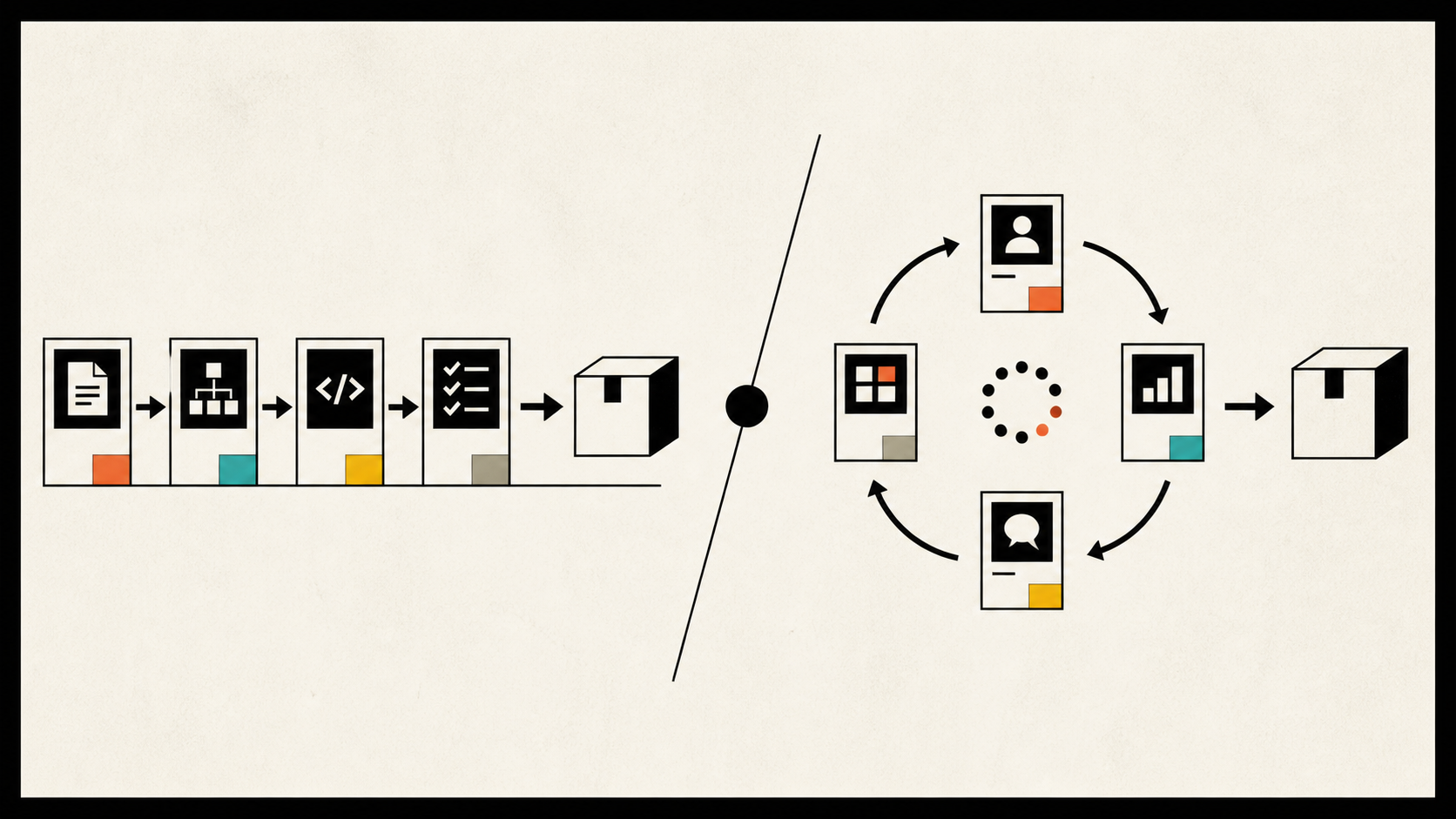
The funniest part is that many "Agile" teams are running waterfall in two-week cycles.
First comes planning. Then design. Then development. Then QA. Then review. Then release. If any step slips, everything slips. The sprint becomes a tiny project plan with a tiny deadline.
The team gets the stress of waterfall and the meeting load of Scrum.
Real agility comes from shortening feedback loops, not from renaming phases. Design, engineering, QA, product, and stakeholders need to collaborate earlier. Risk should be discovered while the work is still cheap to change. A feature should be sliced so part of it can become real before the entire idea is fully polished.
The question is not, "Are we using Scrum?"
The question is, "How quickly do we learn whether this work is correct?"
The delivery method is only useful if it changes behavior
A delivery method should improve the way a team makes decisions.
If Scrum helps the team focus, reduce work in progress, expose blockers, and ship useful increments, keep it. If Kanban gives better flow because the work is interrupt-heavy, use that. If a regulated environment needs more upfront planning, do it intentionally and keep feedback loops inside the plan.
The label matters less than the behavior.
Good software delivery tends to have the same shape regardless of method:
- Clear priorities.
- Small batches of work.
- Fast feedback from real users or real systems.
- Visible blockers.
- A team that can change course when evidence changes.
Scrum is one way to support that. It is not the only way.
What teams should do instead
Start by separating the framework from the goal.
The goal is not to run perfect ceremonies. The goal is to deliver valuable software reliably while learning fast enough to avoid building the wrong thing.
That means teams should be honest about what their process is doing:
- If standups are status reports, change them into blocker removal.
- If sprint planning is overcommitted, plan less and finish more.
- If retrospectives do not change anything, pick one action and make it visible.
- If velocity is used to judge people, stop pretending it is a planning tool.
- If users only see work after months, slice features smaller.
Agile is not proven by the calendar. It is proven by the team's ability to respond to reality.
The honest conclusion
Scrum and Agile are related, but they are not the same thing.
Scrum is a framework that can help a team create rhythm and discipline. Agile is the deeper principle: deliver working software, learn from feedback, collaborate closely, and adapt when the plan meets reality.
Teams get software delivery wrong when they copy the ceremonies but miss the reason behind them.
Do Scrum if it helps. Drop parts of it if they do not. Borrow from Kanban, Waterfall, Shape Up, or whatever else fits the work. But keep the real question in view:
Are we learning fast enough to ship the right thing?