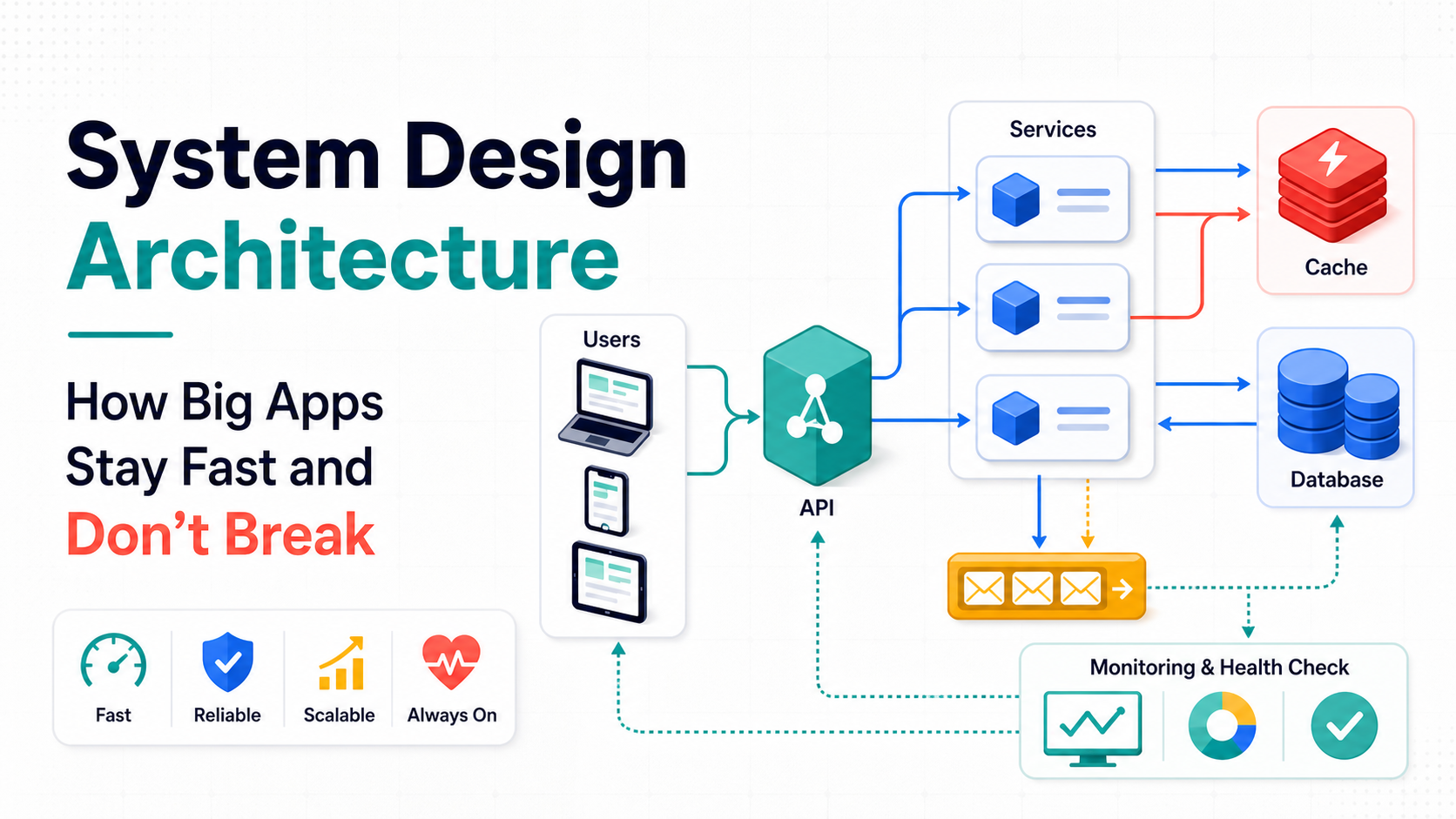
What this actually means
System design architecture is the behind-the-scenes setup that keeps an app running without turning into chaos the moment people actually start using it.
It is not just, "where do we put the database?" or "how many servers do we need?" It is more like: how do all the parts of the system talk to each other, stay fast, survive failures, and still make sense six months later when the team adds ten new features?
Think of it as the floor plan for your software. If the layout is bad, everyone keeps bumping into walls.
Why it matters
When an app is tiny, life is easy. One server, one database, a few APIs, done. Cute.
But then users show up. Traffic grows. Product asks for new features. Someone wants real-time notifications. Someone else wants analytics. Suddenly, the "simple app" is doing a lot.
Without solid architecture, things get messy fast:
- Pages load slowly
- The database starts sweating
- Bugs become hard to trace
- Deployments feel scary
- One broken feature somehow takes down everything
Good system design keeps the app from becoming a group project where nobody knows who did what.
The main pieces
Most systems have a few core parts.
The frontend is what users see and click. Web app, mobile app, dashboard, whatever.
The backend is where the actual logic lives. It handles requests, checks rules, talks to the database, and decides what happens next.
The database stores the important stuff: users, orders, messages, payments, settings, all the things the app needs to remember.
Then there is infrastructure, which is the support crew: servers, cloud services, deployment pipelines, monitoring, networking, and all the invisible machinery keeping things alive.
If these parts have clear responsibilities, the system feels clean. If not, welcome to spaghetti season.
Monolith vs microservices
A monolith means most of the app lives in one big codebase. And honestly? That is not a bad thing.
For early-stage products, monoliths are usually faster to build, easier to debug, and simpler to deploy. You can move quickly without managing a bunch of tiny services talking over the network.
Microservices split the app into smaller services. One service for payments, one for auth, one for notifications, and so on. Sounds fancy, and sometimes it is useful.
But microservices also come with extra drama: network issues, service coordination, distributed debugging, more deployment complexity, and more things that can break independently.
So no, microservices are not automatically "senior engineer energy." Sometimes they are just expensive chaos with better branding.
Scaling without panicking
Scaling means your system can handle more users, more requests, and more data without having a full breakdown.
You can scale up by using a bigger machine. You can scale out by adding more machines.
Common moves include:
- Load balancers to spread traffic
- Caching so you do not ask the database the same thing 500 times
- Database indexes so queries do not crawl
- Queues for background jobs
- CDNs so images and files load faster
- Read replicas when lots of people are reading data
The trick is not to throw every scaling trick into the app on day one. That is how you end up with a spaceship when you only needed a bike.
Find the bottleneck first. Then fix that.
Failure is part of the plot
Systems fail. That is not being negative, that is just production.
Servers crash. APIs time out. Databases slow down. Payment providers act mysterious. Networks do network things.
Good architecture expects failure and makes sure one bad part does not ruin the whole app.
That means using things like retries, timeouts, backups, health checks, and fallback behavior.
Example: if the recommendation service breaks, the app can still show trending products instead of giving users a blank page. Not perfect, but way better than "oops, everything is broken."
Data is where things get real
Data design matters because it is one of the hardest things to change later.
You need to decide what goes into the database, how tables or collections are structured, what should be indexed, what needs transactions, and what can be eventually consistent.
Relational databases are great when structure and accuracy matter. NoSQL can be helpful when the data shape is flexible or the workload is huge. Caching can make reads faster, but cache invalidation is its own mini boss fight.
Basically, data decisions age quickly if you do not think them through.
Observability: because guessing is embarrassing
If something breaks in production, you need to know what happened.
That is where logs, metrics, traces, alerts, and dashboards come in.
Observability helps answer questions like:
- Is the app slow?
- Which service is failing?
- Did the latest release break something?
- Are users affected?
- Is the database the problem, or is it the API?
Without observability, debugging is just vibes and panic.
Security cannot be an afterthought
Security is not something you sprinkle on at the end.
A good system needs authentication, authorization, encryption, secret management, input validation, rate limiting, and audit logs.
Also, every user and service should only get access to what they actually need. No random admin privileges. No "we will fix it later." That is how incidents are born.
Build for change
The best architecture is not the fanciest one. It is the one that fits the product right now and can evolve later.
Early on, optimize for clarity and speed. As the product grows, introduce stronger boundaries, better tooling, and more scalable patterns where they actually make sense.
Over-engineering too early is just procrastination wearing a tech lead hoodie.
Final take
System design architecture is how you build software that does not fold under pressure.
It helps your app stay fast, understandable, reliable, and easier to change. It also helps teams move without constantly breaking things.
The goal is not to build the most impressive diagram. The goal is to build something that works, survives growth, and does not make future-you question every life decision.